

Emerging Markets

Luiz Inácio Lula da Silva’s re-election on October 25, 2026, does not mark a decisive political shift in Brazil. It nevertheless opens a period of uncertainty for financial markets, as the president will have to contend with a Congress dominated by the right and increasingly fragile public finances. Beyond the election result, the credibility of fiscal policy will be the key factor shaping Brazil’s economic and financial outlook.
Lula secured a narrow victory in the presidential runoff, winning 51.8% of the vote against 48.2% for Flávio Bolsonaro. However, the legislative elections have produced a much less favourable political landscape for the newly re-elected president.
From February 2027, the Liberal Party (PL), associated with the Bolsonaro movement, will become the largest political force in both chambers of Congress. Together with its conservative allies, the right will have enough seats to block constitutional amendments, which require a three-fifths majority in each chamber.
Lula will therefore have to revive Brazil’s traditional coalition-based presidential system, seeking support from centrist and centre-right parties. This should allow the government to pass routine legislation and the 2027 budget, but at the cost of further political concessions and ministerial appointments. Major structural reforms, particularly those affecting mandatory public spending, will be much harder to implement.
The new political configuration significantly limits the executive’s room for manoeuvre: Lula retains the presidency, but lacks the parliamentary support needed to reshape Brazil’s fiscal framework.
Financial markets had largely priced in a victory for Flávio Bolsonaro, who was seen as more likely to pursue fiscal adjustment. The election result therefore triggered a sharp sell-off in Brazilian assets.
On October 26, the Ibovespa fell by 13.9%, while the real depreciated by 8.2% against the US dollar, its worst daily performance since 1999. At the same time, long-term interest rates surged by more than 260 basis points, exceeding 15%.
This reaction reflects less concern about political stability than about Brazil’s fiscal trajectory. Investors fear that Lula’s campaign commitments, particularly those involving higher social spending, could further undermine public finances.
The appointment of the next Finance Minister and the government’s first fiscal measures will therefore be critical. A candidate perceived as credible by financial markets could help stabilise expectations. Conversely, additional unfunded spending commitments would risk prolonging pressure on the currency and government bond yields.
Public finances represent the main challenge of Lula’s next term. Gross public debt reached 82.9% of GDP in August 2026, up 5.5 percentage points over twelve months. Its increase is largely driven by the exceptionally high interest burden, which now amounts to around 9% of GDP.
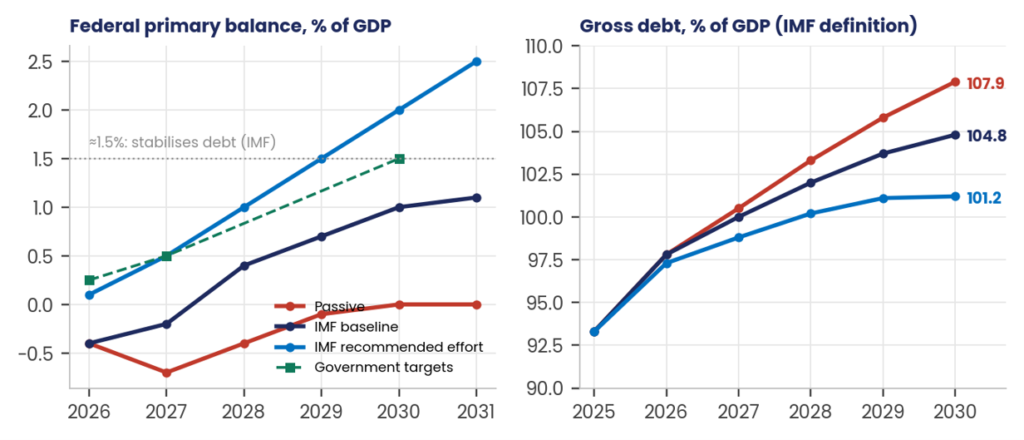
Stabilising the debt ratio would require a primary fiscal adjustment of approximately 3 percentage points of GDP. Yet the government’s target for 2027 is only a 0.5% primary surplus.
The gap between the adjustment required and the government’s stated objectives is particularly concerning given the rigidity of public expenditure. Around 90% of federal spending is mandatory, while pensions and numerous social benefits are indexed to the minimum wage or inflation.
Reforming these mechanisms would require a constitutional majority that the new Congress is unlikely to provide. The risk is therefore one of insufficient fiscal adjustment and a continued increase in public debt.
According to the IMF’s baseline scenario, debt could reach 108% of GDP by 2030 in the absence of additional corrective measures. Even the fiscal effort recommended by the institution would not be sufficient to put the debt ratio on a sustainable downward path.
Brazil’s fiscal difficulties also have direct implications for monetary conditions and the cost of financing the economy.
With the Selic policy rate at 13.75% and inflation reaching 4.6% in September 2026, Brazil continues to have one of the highest real interest rates among major emerging markets.
This situation is not simply a cyclical monetary policy response. It reflects several structural factors: the large share of subsidised credit, the indexation of a significant proportion of public debt to the policy rate, and the rigidity of government expenditure.
Around 43% of outstanding credit benefits from capped or subsidised interest rates. Monetary policy is therefore less effective than in other economies, forcing the central bank to maintain particularly high rates to contain inflationary pressures.
Furthermore, approximately half of federal public debt is indexed to the Selic rate. Any increase in interest rates therefore directly raises government financing costs, reinforcing the vicious circle between public debt and borrowing costs.
Against this backdrop, TAC ECONOMICS expects GDP growth of 1.8% in 2026 and 1.7% in 2027. Investment, already limited to around 16% of GDP, remains constrained by high financing costs and fiscal uncertainty. A sustainable recovery would require structural reforms that currently appear politically difficult to achieve.
Despite these domestic vulnerabilities, Brazil benefits from several buffers against financial instability.
Foreign direct investment inflows reached 3.4% of GDP over the twelve months to August, comfortably covering the current account deficit, estimated at 2.5% of GDP. Foreign exchange reserves stand at USD 373 billion, while 96% of federal debt is denominated in local currency.
Brazil also benefits from its position as a net oil exporter and from the gradual diversification of its export markets. As the share of the United States in Brazilian exports declines, sales to the European Union and India are increasing, partially reducing the country’s exposure to US trade tensions.
These factors limit the risk of a balance-of-payments crisis comparable to those experienced in the past. However, they do not shield the real from persistent volatility, particularly if fiscal uncertainty fuels capital outflows and expectations of further currency depreciation.
Lula’s re-election therefore opens less a new phase of economic transformation than a period of political bargaining and financial vulnerability.
Four possible trajectories emerge: partial fiscal re-anchoring through the appointment of a credible Finance Minister and adherence to existing targets; a continuation of the status quo accompanied by additional spending; a more ambitious fiscal adjustment, although politically unlikely; or, in an extreme scenario, a loss of confidence in the fiscal framework, triggering further financial instability.
The central challenge is Brazil’s fiscal trilemma: the country cannot easily maintain high market-driven real interest rates to preserve monetary stability, retain its existing fiscal and social model, and ensure public debt sustainability at the same time.
For international investors and businesses, Brazil’s main risk is therefore less an immediate external crisis than the government’s ability to restore fiscal credibility. Until this issue is addressed, interest rates are likely to remain high, investment subdued and the currency exposed to further bouts of volatility.